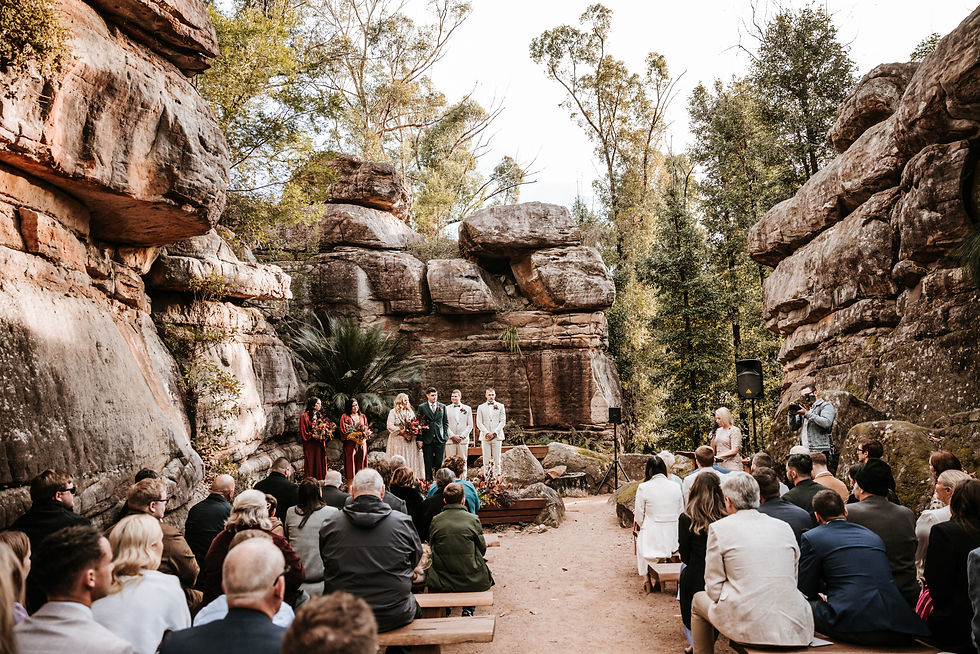
Outdoor Wedding Venues in NSW: How to Compare Them Properly
Updated: Sep 29
When couples start looking at outdoor wedding venues in NSW, they often find the same problem very quickly:
everything begins to look appealing, but not necessarily comparable.
One venue has:
extraordinary views
Another has:
stronger accommodation
Another feels:
beautifully styled and polished
Another feels:
more private and immersed in nature
Another looks:
effortless in photos
But none of those things, on their own, tells you whether the venue is actually the right one for your wedding.
That is where many outdoor venue decisions start to go wrong.
Because outdoor venues are often compared through the least useful filters:
how beautiful they look at first glance
how well they photograph
whether the ceremony site feels dramatic
or whether the venue seems to fit a broad mood-board idea
Those things matter.
But an outdoor venue is not just a backdrop.
It is a working environment for:
the ceremony
guest arrival
comfort
weather shifts
movement
recovery
celebration flow
and, often, the broader feel of the whole wedding
That means the right outdoor venue is rarely just the most scenic one.
It is the one that:
creates the atmosphere you want
works well in real conditions
supports your guest mix
and suits the kind of outdoor wedding you are actually trying to have
This guide is designed to help you compare outdoor wedding venues in NSW through that more useful lens.
By the end, you should feel clearer on:
the main types of outdoor wedding venues in NSW
what couples often get wrong when comparing them
how to assess atmosphere, readiness, and guest comfort together
when accommodation changes the value of an outdoor venue
and how to choose the kind of outdoor venue that fits your wedding best
Quick answer: how should couples compare outdoor wedding venues in NSW?
The best way to compare outdoor wedding venues in NSW is to judge them on three things together: atmosphere, outdoor readiness, and guest experience. A venue needs to feel beautiful, work well in real conditions, and support the kind of wedding you actually want to have.
That means asking:
What kind of outdoor setting are we actually drawn to?
Is this venue beautiful only, or also usable?
Will guests feel comfortable here for the full wedding?
Does the venue have credible weather resilience?
What type of outdoor wedding does this venue naturally support?
Does accommodation or stay logic make the venue work better?
A strong outdoor venue usually does not win on one thing alone.
It wins because:
the setting feels right
the wedding format fits the site
the comfort is well considered
and the practical side of the day does not erode the atmosphere
That is what you are really comparing.
Why most outdoor venue comparisons are less useful than they look
A lot of outdoor venue comparison content is built around:
beauty
popularity
broad regional appeal
and visual inspiration
That is fine for discovery.
It is not enough for judgement.
Because outdoor venues differ in ways that matter far more in practice than they do on a list.
For example, two venues may both appear to be:
nature-led
scenic
and “perfect for an outdoor wedding”
But one may be:
weather-resilient
guest-friendly
easy to move through
and well suited to a full wedding day
while the other may be:
highly exposed
difficult for mixed-age guests
visually strong but operationally fragile
and best suited only to a short ceremony moment
Those are not small differences.
They shape:
guest comfort
emotional tone
pace
and how much pressure the wedding carries
This is why outdoor venues need to be compared through a stronger framework than:
which one is prettier
which one feels trendier
or which one sounds most romantic in a description
The right outdoor venue is not just a place with a beautiful ceremony site.
It is a place that can carry the whole experience well.
The main types of outdoor wedding venues in NSW
One of the easiest ways to compare outdoor venues properly is to start by comparing venue types, not just venue names.
Different outdoor settings naturally support different kinds of weddings.

1. Garden venues
These often suit couples wanting:
softness
visual polish
floral atmosphere
and outdoor beauty without too much ruggedness
Garden venues often feel:
more curated
easier to navigate
and more comfortable for broad guest groups
Best for
elegant outdoor ceremonies
lower-friction outdoor formats
couples who want outdoor beauty with stronger comfort support
Watchouts
may feel less immersive or less connected to wild landscape
sometimes more decorative than place-led

2. Meadow or paddock venues
These often suit couples wanting:
open sky
relaxed country atmosphere
and a wedding that feels expansive and informal in the best sense
They often feel:
airy
bright
and strongly open to the landscape
Best for
open-country energy
couples drawn to light, horizon, and rural atmosphere
Watchouts
exposure to sun, wind and weather
weak shade and shelter if poorly designed
sound and ceremony comfort may be weaker than the visuals suggest

3. Bushland or forest venues
These often suit couples wanting:
nature-led immersion
privacy
stronger atmosphere
and a wedding that feels genuinely grounded in landscape
They often feel:
more secluded
more emotionally distinctive
and less conventional
Best for
couples prioritising atmosphere, privacy and a stronger connection to place
destination-style or stay-based weddings when accommodation is strong
Watchouts
access, movement, terrain, light and comfort all matter more
not every nature venue is genuinely guest-ready

4. Coastal outdoor venues
These often suit couples wanting:
openness
scenic water-adjacent atmosphere
a lighter destination feel
and strong guest appeal
They often feel:
airy
relaxed
and naturally celebratory
Best for
couples drawn to coastal mood and holiday-like destination energy
Watchouts
wind, exposure, traffic, and accommodation spread
a beautiful coastal setting can still be difficult to inhabit comfortably

5. Estate or regional property venues
These often suit couples wanting:
broader regional appeal
stronger structure
outdoor beauty within a more established venue model
and a balance of atmosphere with operational support
They often feel:
polished
easier to contextualise
and suitable for a broad range of wedding formats
Best for
couples wanting outdoor beauty with more structure and clarity
Watchouts
true outdoor readiness varies widely
some are scenic but rely heavily on ideal weather

6. Retreat-style accommodation-led venues
These often suit couples wanting:
outdoor atmosphere plus shared experience
privacy
accommodation
and a wedding that feels more like a place-based gathering than a one-day event
They often feel:
more immersive
more private
and more socially connected
Best for
destination-style outdoor weddings
couples wanting guests to stay and settle in
Watchouts
need strong design and good format discipline
work best when the guest group suits the stay-based model

7. Hybrid indoor-outdoor venues
These often suit couples who want:
meaningful outdoor experience
but lower overall fragility
They usually combine:
outdoor ceremony or drinks settings
with stronger sheltered or indoor celebration space
Best for
mixed-age guest lists
weather-sensitive planning
couples wanting outdoor atmosphere without carrying full outdoor exposure all day
Watchouts
may feel less dramatically “outdoors” to some couples
transition quality matters a lot
The main types of outdoor wedding venues in NSW
Venue Type | Best For | Strengths | Watchouts |
Garden venue | Soft outdoor elegance | Comfort, structure, visual polish | Can feel less immersive |
Meadow / paddock | Open-country atmosphere | Space, light, relaxed energy | Exposure, shade, weather |
Bushland / forest | Nature-led immersion | Privacy, atmosphere, emotional distinctiveness | Access, terrain, comfort, light |
Coastal outdoor | Open scenic weddings | Holiday feel, guest appeal, visual openness | Wind, traffic, exposure, stay spread |
Estate / regional property | Polished regional weddings | Beauty, structure, broad appeal | Varies in true outdoor readiness |
Retreat-style venue | Shared-experience weddings | Accommodation, privacy, stronger destination logic | Needs strong design and guest-fit |
Hybrid indoor-outdoor | Lower-friction outdoor weddings | Resilience, comfort, flexibility | May feel less dramatically outdoors |
What couples often get wrong when comparing outdoor venues
Outdoor venues are easy to romanticise.
That is not a flaw. It is a very human response. But it does create predictable mistakes.
1. Choosing for views alone
The first mistake is mistaking a beautiful outlook for a complete venue.
A strong view tells you almost nothing on its own about:
guest comfort
ceremony usability
weather resilience
night-time movement
or how the full wedding will feel
2. Comparing unlike-for-unlike
Couples often compare:
a garden venue
a bushland retreat
a coastal ceremony site
and a hybrid estate
as though they are all trying to do the same thing.
They are not.
Different outdoor venue types solve different problems.
3. Underestimating guest comfort
A setting may feel emotionally perfect for the couple but still be:
too exposed
too awkward
too fragmented
or too effortful for guests
Outdoor comfort is not a side issue. It is one of the conditions that lets atmosphere hold.
4. Treating fallback as an afterthought
An outdoor venue is not really strong if the fallback:
feels second-rate
destroys the tone
or works only in theory
A good outdoor venue comparison needs to include:
what happens if conditions shift
and whether the wedding still feels coherent if they do
5. Ignoring accommodation and travel
Some outdoor venues become far stronger when guests can:
stay nearby
arrive more gently
and leave without pressure
Others look good in theory but ask too much of same-day guests.
These are all reasons why outdoor venue comparison needs more than mood and visuals.
Atmosphere, readiness, and guest comfort: the three filters that matter most
A practical outdoor venue comparison becomes much easier once you focus on three filters.
1. Atmosphere
This is about:
emotional tone
sense of place
what the setting contributes
and whether the wedding feels more alive because of where it is happening
Atmosphere includes:
openness
intimacy
privacy
landscape character
and how the venue feels in the body, not just the eye
2. Readiness
This is about whether the venue is truly ready to host a real outdoor wedding.
That includes:
ceremony usability
shelter
paths
fallback quality
sound
movement
amenities
lighting
and resilience across real conditions
Readiness is where many scenic venues underperform.
3. Guest comfort
This is about whether guests can:
stay present
remain physically comfortable
move easily
and enjoy the celebration without the setting feeling like hard work
Comfort includes:
shade
seating
exposure
access
amenities
recovery spaces
and the logic of the venue across the full day
A simple comparison rule
A strong outdoor venue usually does three things well at once:
it feels special
it works well
and it feels generous to guests
If one of those is missing, the venue often weakens considerably in practice.
Outdoor ceremony only, hybrid outdoor, or fully outdoor: what kind of venue do you actually need?
Another reason couples get stuck is that they often say:
“We want an outdoor wedding.”
But that can mean several quite different things.
1. Outdoor ceremony only
This format usually prioritises:
ceremony atmosphere
a strong outdoor moment
and less exposure across the full event
It often works best for:
mixed-age guest lists
lower-friction weddings
couples who want outdoor meaning without all-day outdoor dependency
2. Hybrid outdoor wedding
This usually means:
outdoor ceremony and perhaps drinks
with indoor or sheltered celebration later
This is often one of the strongest and most resilient models.
It gives:
atmosphere
better guest comfort
stronger fallback logic
and less fragility
3. Fully outdoor wedding
This format is the most immersive, but also the most operationally demanding.
It can be incredible when:
the venue is extremely well designed
the guest fit is strong
the weather logic is good
and the comfort and transition planning are excellent
It is weaker when:
exposure accumulates
movement is awkward
or the venue is relying more on beauty than on readiness
This is why the right venue type depends partly on the kind of outdoor wedding you are actually trying to create.
Why accommodation changes the value of many outdoor venues
Accommodation matters in many weddings. In outdoor weddings, it often matters even more.
That is because outdoor weddings already place more weight on:
guest energy
comfort
weather recovery
timing
and pace
Accommodation can improve all of those things.
It lowers travel pressure
Guests do not need to arrive rushed or leave under late-night pressure.
It improves comfort recovery
Guests can:
reset
change layers
rest
cool down
warm up
and return to the celebration with more ease
It strengthens destination payoff
The more a venue feels like a place guests can inhabit, the more worthwhile the outdoor setting often becomes.
It supports shared experience
Accommodation often turns a scenic outdoor venue into a more connected and memorable wedding environment.
This is especially true for:
retreat-style venues
regional outdoor weddings
destination-style formats
and weddings where the setting itself is part of the appeal
A venue does not always need accommodation to be excellent. But in many outdoor weddings, accommodation lifts the value of the venue far beyond the ceremony alone.
Scenic venue versus outdoor-ready venue
A scenic venue gives you:
beauty
views
visual mood
a strong first impression
An outdoor-ready venue gives you:
beauty plus usability
views plus guest comfort
atmosphere plus resilience
and a setting that can carry the full event, not just a photo moment
Scenic vs ready
Scenic Venue | Outdoor-Ready Venue |
Wins on first impression | Holds up over the full event |
Strong visually | Strong visually and operationally |
May rely on ideal weather | Has credible resilience |
May create guest strain | Protects guest ease and comfort |
Easy to romanticise | Easier to trust in practice |
This is a very useful reality check.
If a venue only seems perfect:
at a certain time of day
in perfect weather
from certain angles
or when you are imagining only the ceremony
then it may be scenic more than truly ready.
That does not mean it is bad.
It means you need to assess what kind of wedding it can really support.
Download the Outdoor Readiness Checklist to assess ceremony usability, comfort, movement, fallback strength, and what happens when conditions are less than ideal.
A simple NSW outdoor venue comparison framework
Use this framework to compare outdoor venues more clearly.
Category | What to Assess | Better Question |
Atmosphere | The emotional feel of the setting | Does this venue create the kind of outdoor experience we want? |
Readiness | Shelter, ceremony strength, fallback, movement | Is this venue truly ready for a real outdoor wedding? |
Guest comfort | Shade, seating, terrain, amenities | Will guests feel looked after here? |
Format fit | Ceremony-only, hybrid, fully outdoor, stay-based | What type of outdoor wedding does this venue naturally support? |
Accommodation | Stay logic and travel relief | Does staying nearby or on-site improve the experience meaningfully? |
Overall fit | Practical and emotional alignment | Is this the right kind of outdoor venue for us, not just an attractive one? |
A quick outdoor venue comparison test
You are probably comparing well if:
you know what kind of outdoor setting you actually want
you are comparing venue types, not just images
guest comfort matters to you as much as atmosphere
you understand the venue’s weather resilience
you know whether accommodation improves the format
A practical way to build your outdoor venue shortlist
Once you understand the different kinds of outdoor venues available, the next step is to reduce a long list to a small number of genuinely strong options. The aim is not to collect the most beautiful venues. It is to identify the places most capable of delivering the wedding experience you actually want.
Step 1: Decide on the outdoor format first
Start with the experience rather than individual venues. Do you want an outdoor ceremony with an indoor reception, a hybrid indoor-outdoor celebration, or a more immersive nature-led wedding where the setting shapes the whole stay? Removing venues that cannot support your preferred format makes every later comparison more useful.
Step 2: Apply an outdoor-readiness filter
Assess the remaining venues against the same practical criteria: landscape and atmosphere, guest comfort, weather readiness, movement and flow, and accommodation or transport logistics. A beautiful view is valuable, but it should not compensate for a venue that becomes difficult once guests, weather and the full wedding day are considered.
Step 3: Score the shortlist rather than keeping a favourites list
A simple scorecard helps separate emotional first impressions from genuine fit. Use the same criteria for every venue and note where each one is strong, acceptable or weak. This makes it much easier to see why one venue belongs on the shortlist and another does not.
Step 4: Look for red flags before you tour
Useful warning signs include a striking ceremony setting with weak supporting spaces, a wet-weather option that feels like a downgrade, unclear accommodation or transport logic, difficult terrain that has not been thoughtfully managed, or answers that reassure without clearly explaining how the day works in practice.
Step 5: Tour only the strongest options
A practical process might take an initial list of 15 venues down to eight after the format filter, then to four after assessing readiness, comfort and logistics. Visiting three to five genuinely strong contenders is usually more useful than touring ten venues that were never really comparable.
The point of shortlisting is not to remove emotion from the decision. It is to make sure the venues that reach the emotional decision stage have already earned their place there.
For the broader decision framework, explore our Outdoor, Nature & Wilderness Weddings guide.
If you want to see how those criteria translate into a complete NSW venue, explore Kangaroo Valley Bush Retreat as a wedding venue.
Frequently asked questions
What should couples look for in an outdoor wedding venue in NSW?
They should look at atmosphere, ceremony usability, shelter, movement, guest comfort, weather resilience, accommodation, and whether the venue suits the kind of outdoor wedding they actually want.
What is the difference between a scenic outdoor venue and an outdoor-ready one?
A scenic venue looks beautiful. An outdoor-ready venue also works well across real conditions, protects guest comfort, and can carry the full wedding more reliably.
Are hybrid indoor-outdoor venues a better option?
Often, yes, especially for couples wanting outdoor atmosphere with stronger comfort and lower fragility. They are one of the most balanced outdoor wedding formats.
Do outdoor wedding venues in NSW need accommodation nearby?
Not always, but accommodation can meaningfully improve arrival ease, guest comfort, late-night logistics, and the overall value of many regional or destination-style outdoor weddings.
How do you compare different outdoor venue types properly?
By comparing them through atmosphere, readiness, guest comfort, format fit, and accommodation logic rather than only views, styling, or region name.
What is the biggest mistake couples make when choosing an outdoor venue?
Usually choosing for beauty alone without properly assessing whether the venue is guest-ready, weather-resilient, and right for the type of outdoor wedding they actually want.
Final thought
The best outdoor wedding venue in NSW is rarely the one that only looks the most impressive in a still image.
It is usually the one that can hold:
the atmosphere
the guests
the weather reality
the movement of the day
and the emotional tone of the wedding
with the least strain and the most grace.
That is what makes an outdoor venue truly strong.
If you are comparing venues now, one of the most useful questions you can ask is:
Would this venue still feel like the right choice once the whole wedding is happening inside it, not just the moment we first saw it?
That question usually reveals a lot.
Download the Outdoor Readiness Checklist
Use the full checklist to compare venues properly and assess comfort, weather resilience, flow, accommodation, and logistics before you shortlist.


Continue your planning
See what makes a wedding venue genuinely outdoor-ready or explore outdoor weddings at Kangaroo Valley Bush Retreat.
If KVBR feels like it could suit your celebration, request the wedding brochure and pricing to explore the venue in more detail.